Friday, April 22, 2016

Car Seats: Information for Families


One of the most important jobs you have as a parent is keeping your child safe when riding in a vehicle. Each year, thousands of young children are killed or injured in car crashes. Proper use of car seats helps keep children safe. But with so many different seats on the market, many parents find this overwhelming.
The type of seat your child needs depends on several things, including your child's age and size and the type of vehicle you have. Read on for more information from the American Academy of Pediatrics (AAP) about choosing the most appropriate car seat for your child.
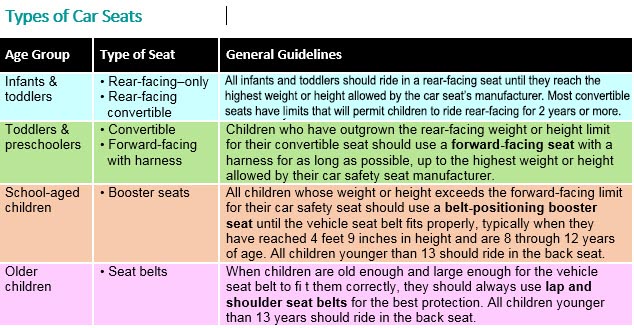
grid

Car seats may be installed with either the vehicle's seat belt or LATCH (lower anchors and tethers for children) system. 

What is LATCH?
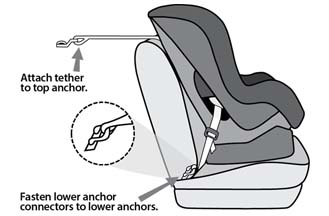
LATCH is an attachment system for car seats. Lower anchors can be used instead of the seat belt to install the seat, and many parents find them easier to use in some cars. The top tether improves safety provided by the seat and is important to use for all forward-facing seats, even those installed using the vehicle seat belt. These systems are equally safe, but in some cases it may be easier to install the car seat using one or the other.
Vehicles with the LATCH system have lower anchors located in the back seat, where the seat cushions meet. Tether anchors are located behind the seat, either on the panel behind the seat (in sedans) or back of the seat, ceiling, or floor (in most minivans, SUVs, and hatchbacks). All car seats have attachments that fasten to these anchors. Nearly all passenger vehicles and all car seats made on or after September 1, 2002, are equipped to use LATCH.
All lower anchors are rated for a maximum weight of 65 pounds (total weight includes car seat and child). Parents should check the car seat manufacturer's recommendations for maximum weight a child can be to use lower anchors. New car seats have the maximum weight printed on their label.
If you install a car seat using your vehicle's seat belt:
You must make sure the seat belt locks to help get a tight fi t. In most newer cars, you can lock the seat belt by pulling it all the way out and then allowing it to retract to keep the seat belt tight around the car seat. Additionally, many car seats have built-in lock-offs to lock the belt without having to lock the seatbelt as well. Refer to the vehicle owner's manual for details about how your seat belt locks.
The safest place to ride for all children younger than 13 years is the back seat. If possible, it may be best to ride in the middle of the back seat. However, it is sometimes difficult to install a car seat tightly in the middle if the vehicle seat is narrow or uneven. Also, most vehicles do not have lower anchors for the middle seating position. It is safest to put the car seat in a position where you can install it tightly with either the lower anchor system or seat belt; in some cases, this may be on either side of the back seat rather than the middle. A child passenger safety technician (CPST) can help you decide which place is best to install your child's car seat in your vehicle.
The AAP recommends that all infants ride rear facing starting with their first ride home from the hospital. All infants and toddlers should ride in a rear-facing seat until they are at least 2 years of age or, preferably, until they reach the highest weight or height allowed by their car seat manufacturer.
Rear-facing–only seats
  • Are used for infants up to 22 to 45 pounds, depending on the model.
  • Are small, have carrying handles, and sometimes come as part of a stroller system.
  • Usually come with a base that can be left in the car. The seat clicks into and out of the base so you don't have to install it each time you use it. Parents can buy more than one base for additional vehicles.
  • Should be used only for travel (not sleeping, feeding, or any other use outside the vehicle).

Convertible seats (used rear facing)

  • Can be used rear facing and, later, "converted" to forward-facing for older children when they outgrow the weight limit, the length limit, or both for rear facing. This means the seat can be used longer by your child. They are bulkier than infant seats, however, and do not come with carrying handles or separate bases.
  • Many have higher limits in rear-facing weight (up to 40–50 pounds) and height than rear-facing–only seats, which make them ideal for bigger babies and toddlers.
  • Have a 5-point harness that attaches at the shoulders, at the hips, and between the legs.
  • Should be used only for travel (not sleeping, feeding, or any other use outside the vehicle).

3-in-1 seats (used rear facing)

  • Can be used rear facing, forward facing, or as a belt-positioning booster. This means the seat may be used longer by your child as your child grows.
  • Are often bigger in size, so it is important to check that they fit in the vehicle while rear facing.
  • Do not have the convenience of a carrying handle or separate base; however, they may have higher limits in rear-facing weight (up to 40–50 pounds) and height than rear-facing–only seats, which make them ideal for bigger babies and toddlers.




Thursday, April 21, 2016

Juvenile rheumatoid arthritis

Juvenile rheumatoid arthritis, also known as juvenile idiopathic arthritis, is the most common type of arthritis in children under the age of 17. Juvenile rheumatoid arthritis causes persistent joint pain, swelling and stiffness. Some children may experience symptoms for only a few months, while others have symptoms for the rest of their lives.
Some types of juvenile rheumatoid arthritis can cause serious complications, such as growth problems and eye inflammation. Treatment of juvenile rheumatoid arthritis focuses on controlling pain, improving function and preventing joint damage.
Symptoms
The most common signs and symptoms of juvenile rheumatoid arthritis are:
  • Pain. While your child might not complain of joint pain, you may notice that he or she limps — especially first thing in the morning or after a nap.
  • Swelling. Joint swelling is common but is often first noticed in larger joints like the knee.
  • Stiffness. You might notice that your child appears clumsier than usual, particularly in the morning or after naps.
Juvenile rheumatoid arthritis can affect one joint or many. In some cases, juvenile rheumatoid arthritis affects the entire body — causing swollen lymph nodes, rashes and fever.
Like other forms of arthritis, juvenile rheumatoid arthritis is characterized by times when symptoms flare up and times when symptoms disappear.

When to see a doctor
Take your child to the doctor if he or she has joint pain, swelling or stiffness for more than a week — especially if he or she also has a fever.

Causes-
Juvenile rheumatoid arthritis occurs when the body's immune system attacks its own cells and tissues. It's unknown why this happens, but both heredity and environment seem to play a role. Certain gene mutations may make a person more susceptible to environmental factors — such as viruses — that may trigger the disease.

Lifestyle and home remedies

Caregivers can help children learn self-care techniques that help limit the effects of juvenile rheumatoid arthritis. Techniques include:
  • Getting regular exercise. Exercise is important because it promotes both muscle strength and joint flexibility. Swimming is an excellent choice because it places minimal stress on joints.
  • Applying cold or heat. Stiffness affects many children with juvenile rheumatoid arthritis, particularly in the morning. Although some children respond well to cold packs, most children prefer a hot pack or a hot bath or shower.
  • Eating well. Some children with arthritis have poor appetites. Others may gain excess weight due to medications or physical inactivity. A healthy diet can help maintain an appropriate body weight.
    Adequate calcium in the diet is important because children with juvenile rheumatoid arthritis are at risk of developing weak bones (osteoporosis) due to the disease, the use of corticosteroids, and decreased physical activity and weight bearing.


Disclaimer- Happy Earth Day!


Today is EARTH DAY and your friends at Dreamworks Animation wanted to send you a special way to promote this important day with all of your readers. By clicking the button, they will find a brand new Earth-themed DINOTRUX word search, and crazy clever KING JULIEN Garden Party tips! Hope you have as much fun sharing this as they did making it!! 

Remember you can currently watch all episodes of ALL HAIL KING JULIEN Seasons 1 & 2 as well as DINOTRUX Seasons 1 & 2 on Netflix! 

Have a Happy Earth Day!!!

Inline image 1


EMBED CODE: 


Disclaimer- Happy 90th Birthday Queen Elizabeth!


In celebration of Queen Elizabeth's 90th birthday, April 21st, we have these fun clips to share with you from A Royal Night Out available now on Digital HD and coming to DVD 5/3! This charming reverse Cinderella story is inspired by true events that recounts the celebration of the end of WWII during 1945 in Europe where Princess Elizabeth and Princess Margaret leave the confines of Buckingham Palace to venture out into London for a whirlwind of adventure. 

The film stars Emily Watson (Corpse Bride), Rupert Everett (Shrek The Third, Shrek 2), Sarah Gadon (The Amazing Spider-Man 2) and Bel Powley - Winner of Hamptons International Film Festival "Breakthrough Performer" for her role in this film. 

Please feel free to watch these clips re-living young Princess Elizabeth in honor of her 90th birthday with your darling readers and cheers to her majesty!


Inline image 1


A Royal Night Out - Thrilled for VE Day Film Clip: 
Inline image 3


Embed Code: <iframe width="560" height="315" src="https://www.youtube.com/embed/lRc6f3h-xXo" frameborder="0" allowfullscreen></iframe>

A Royal Night Out - Request Film Clip: 
Inline image 5


Embed Code: <iframe width="560" height="315" src="https://www.youtube.com/embed/OFeCa9Lf_ec" frameborder="0" allowfullscreen></iframe>

How to Celebrate The Queen's Birthday Clip: 
Inline image 4


Preview Link: https://www.youtube.com/watch?v=o3gGGRdv6iQ&feature=youtu.be 
Embed Code: <iframe width="560" height="315" src="https://www.youtube.com/embed/o3gGGRdv6iQ" frameborder="0" allowfullscreen></iframe>


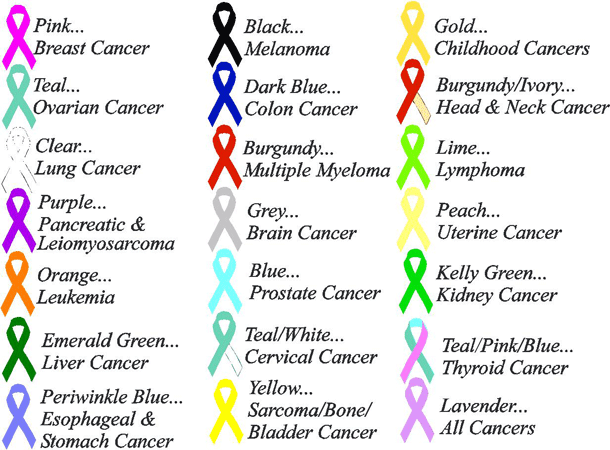
Cancer Ribbons And Meanings


Show your support each and every month by wearing these colors!  Check for signs and symptoms.

Wednesday, April 20, 2016

Ocular Melanoma

Image result for ocular melanoma awarenessOcular melanoma, or melanoma of the eye, is the most common primary eye tumor in adults with around 2,000 new cases diagnosed each year in the United States. Like other melanomas, it begins in melanocytes – the cells that produce the pigment melanin that colors the skin, hair, and eyes, as well as forms moles.

Where does ocular melanoma occur?

Ocular melanoma, also known as uveal melanoma or choroidal melanoma, is usually found in the part of the eye called the uvea, which is composed of:
  • The iris - the colored part of the eye that opens and closes to change the amount of light that enters the eye.
  • The ciliary body - a muscle in the eye that changes the shape of the lens so the eye can focus.
  • The choroid - a layer of tissue that is in the back of the eye, next to the retina, that makes a picture. Choroidal melanomas are the most common type of ocular melanoma.

Frequency, Incidence & Risk Factors

Melanoma of the skin increased in frequency over the last several decades, while such a trend is less evident with ocular melanoma. About 6 people per 1 million are diagnosed with ocular melanoma in the U.S. every year, while invasive melanoma of the skin occurs in approximately 1 in 50 Americans each year. The incidence is similar in other Caucasian populations worldwide. Ocular melanoma accounts for approximately 5-12% of all melanoma cases. Some studies suggest that fair skin type and exposure to UV light may be risk factors. Ocular melanoma tends to occur slightly more often in males than in females and overall risk tends to increase with age.
 Image result for ocular melanoma awareness

OCULAR MELANOMA FACTS

Ocular (uveal) melanoma, or melanoma of the eye, is the most common form of eye cancer in adults. Did you know:
  • Ocular melanoma is not thought to be related to sun exposure
  • Approximately 2,000 Americans are diagnosed with ocular melanoma each year
  • Eye tumors should be treated by an ophthalmologist who specializes in treating ocular melanoma
  • Ocular melanoma spreads to other organs in the body in about half of all cases
  • When ocular melanoma spreads, it most commonly spreads to the liver
Be sure to watch for symptoms of ocular melanoma, which include bulging eyes, change in eye color, poor vision, or red, painful eyes. But remember--some people will not have any noticeable symptoms.


Tuesday, April 12, 2016

*Disclaimer-Sofia is back and with some familiar Disney family faces!


Join Sofia on her adventures into a world of magical books in Disney Junior’s hit series Sofia the First: The Secret Library on DVD June 7th! This new DVD features Sofia teaming up with Merida from Disney’s “Brave” and Olaf from Disney’s “Frozen”! It includes 4 episodes for over an hour and half of princess adventures! Plus a FREE Sofia Necklace Inside!


SOFIA UNLOCKS A SECRET WORLD AND BECOMES STORYKEEPER
OF MAGICAL BOOKS IN

SOFIA THE FIRST: THE SECRET LIBRARY

Available on Disney DVD June 7

Features TWO Special Appearances - Princess Merida (“Brave”)
and Olaf (“Frozen”) – Plus a FREE Sofia Necklace Inside!

Synopsis:                      Sofia's Aunt Tilly returns to give her a gift that will unlock a secret world and appoint Sofia storykeeper of magical books without endings in "Sofia the First: The Secret Library." Follow along as Sofia pursues adventures that will finish the narratives, including rescuing Minimus' brother from an evil prince and setting out on a mission to stop Miss Nettle from stealing all the beautiful snowdrop flowers from the wintery kingdom of Freezenberg. Merida from Disney•Pixar's "Brave" and Olaf from Disney's "Frozen" make special appearances.

Cast:                                           Ariel Winter (ABC TV’s “Modern Family”) as Sofia; Sara Ramirez (ABC TVs "Grey's Anatomy”) as Queen Miranda; and Wayne Brady (TV’s “Let's Make A Deal") as Clover.

Guest Voice Cast:              Josh Gad ("Frozen") as Olaf; Ruth Connell ("Supernatural) as Merida; Bonnie Hunt("Cars") as Aunt Tilly; Eric Stonestreet (ABC TV’s “Modern Family”) as Minimus; Cary Elwes ("The Princess Bride") as Prince Roderick; Dean Norris ("Breaking Bad") as Mazzimo; Megan Mullally ("Will & Grace") as Miss Nettle; and Hugh Bonneville ("Downton Abbey") as the Narrator.

Director:                                 Jamie Mitchell

Executive Producers:      Jamie Mitchell and Craig Gerber

Release Date:                       June 7, 2016

Episodes:                                 Princess Adventure Club
                                                      The Secret Library (Featuring Merida from “Brave”)
                                                      The Princess Ballet
                                                      The Secret Library: Olaf and the Tale of Miss Nettle (Featuring Olaf from “Frozen”)

Ratings:                                    TV-Y (US)
Feature Run Time:            Approximately 90 minutes
Aspect Ratio:                        1.78:1 Widescreen (Enhanced for 16x9 Televisions)
Audio:                                       2.0 Dolby Digital
Languages:                             English, French & Spanish